

Last updated: 11-Sep-2026
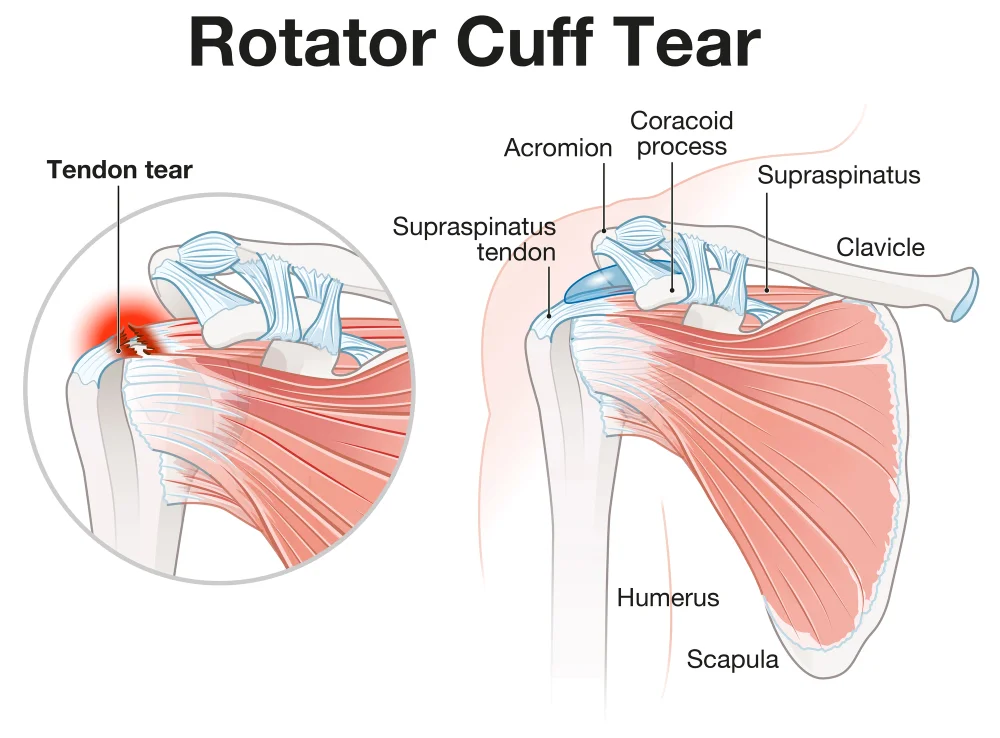
Shoulder rotator cuff repair at LA Orthopedics is an advanced surgery that reattaches torn tendons to the humerus bone. This surgery is intended to reduce shoulder pain and improve strength and function when a repairable rotator cuff tear is contributing to symptoms. Fellowship-trained orthopedic shoulder specialists in Los Angeles use minimally invasive arthroscopy, suture anchors, and precise tissue handling during the procedure. Depending on your tear size, age, and activity level, LA Orthopedics may recommend non-surgical care, arthroscopic repair, or a more complex tendon reconstruction, most of which are done as outpatient procedures.
Trouble reaching overhead, a persistent shoulder ache, or pain that disrupts your sleep can signal a shoulder problem. Rotator cuff problems are one of the top reasons people visit an orthopedic shoulder specialist in Los Angeles. This guide covers the anatomy behind the injury, the warning signs to watch for, how doctors confirm a diagnosis, and what treatment looks like, both with and without surgery.
Not sure if what you're feeling is a strain or something more serious? Talk to an LA Orthopedics shoulder specialist and find out.
Rotator Cuff Anatomy and Types of Tendon Tears
Your shoulder works because of a small team of muscles and tendons. The shoulder joint is a ball-and-socket joint, but the socket is shallow. It needs extra support to stay in place, and the rotator cuff provides it.
Anatomy of the Rotator Cuff: SITS Muscle Complex
The rotator cuff has four muscles and their tendons. Doctors remember them using the acronym SITS:

Drop arm test checks for a large supraspinatus tear
Infraspinatus rotates the arm outward
Teres minor assists with outward rotation
Subscapularis rotates the arm inward
These four tendons wrap around the top of the humerus bone (your upper arm bone). They hold the bone centered in the shoulder socket while still letting your arm move freely. When one or more of these tendons tears, the shoulder loses stability. Simple tasks like lifting a bag or reaching for a shelf can become painful.
Partial-Thickness vs. Full-Thickness Rotator Cuff Tears
Rotator cuff tears come in different forms, and the type you have influences your treatment plan.
Partial-thickness tear: The tendon is frayed or has a shallow tear, but part of it is still attached to the bone.
Full-thickness tear: The tendon is completely torn through and detached from the bone.
A full-thickness tear generally does not reattach to the bone on its own, although pain and function may sometimes improve with nonsurgical treatment.
Acute Traumatic Tears vs. Chronic Degenerative Tendon Loss
Tears also differ in how they happen.
Acute traumatic tears happen suddenly. A fall onto an outstretched arm, a shoulder dislocation, or lifting something heavy the wrong way can cause one.
Chronic degenerative tears develop gradually as tendon quality changes over time. Age-related degeneration, repetitive loading, anatomy, and other intrinsic and extrinsic factors can contribute to progressive tendon damage.
Knowing which type you have helps your surgeon decide whether to wait and treat it conservatively or whether the tear is likely to worsen without surgery.
Recognizing Rotator Cuff Tear Symptoms: When to See a Specialist
Shoulder pain is common. Certain patterns can raise suspicion for a rotator cuff injury, although similar symptoms can occur with other shoulder conditions. Catching these signs early often makes treatment simpler.
Dull Deep Shoulder Ache & Night Pain
A deep, dull ache inside the shoulder is one of the most common rotator cuff tear symptoms. This ache often gets worse at night, especially when you lie on the injured side. Many people live with this pain for weeks or months before seeing a doctor. Night pain is common with rotator cuff disorders and may become more noticeable when lying on the affected shoulder, although the exact reason for nighttime symptoms can vary.
Overhead Weakness & Arm Drop Sign
Weakness is another key symptom, especially when lifting the arm overhead or out to the side. You may notice you can no longer:
Brush your hair with the injured arm
Reach into a high cupboard
Hold a light object with your arm extended
In more severe tears, a person can hold the arm up once someone else places it there, but can’t lift it into that position alone. Doctors call this the arm drop sign.
Crepitus, Popping & Limited Range of Motion
Grinding, popping, or catching sensations during shoulder movement are called crepitus. You may also notice a gap between how far someone else can move your arm (passive motion) and how far you can move it yourself (active motion). This gap is a useful clue during a physical exam. Pain, weakness, and these mechanical symptoms together are strong signs that it is time to see an orthopedic shoulder specialist.
Diagnostic Workflow: How LA Orthopedics Evaluates Shoulder Pain
Evaluation typically begins with a medical history and physical examination. X-rays can help identify arthritis, bone changes, or other causes of shoulder symptoms but do not directly show a rotator cuff tear. When additional soft-tissue detail is needed, MRI or diagnostic ultrasound may be used to evaluate the tendons and surrounding structures.
Specialized Physical Exam & Strength Testing
Shoulder specialists use several tests to determine which tendon may be injured. When these exam findings match imaging results, doctors get a clear, reliable picture of the problem.
Drop arm test checks for a large supraspinatus tear
Empty can test checks supraspinatus strength
Lift-off test checks subscapularis strength
Neer and Hawkins signs check for impingement under the acromion bone
MRI & Ultrasound Imaging
When imaging beyond X-rays is appropriate, MRI or diagnostic ultrasound can provide more detail about the rotator cuff and surrounding soft tissues. MRI can help evaluate tear size, tendon retraction, muscle changes such as fatty infiltration, bursitis, and associated biceps pathology. Diagnostic ultrasound can also identify many rotator cuff tears and may be useful in appropriate cases. The choice of imaging depends on the clinical findings and the information needed for treatment planning.
Non-Surgical Treatment vs. Arthroscopic Surgical Repair
Surgery isn't always the answer for a torn rotator cuff. The right choice depends on tear size, your activity level, and how your shoulder responds to non-surgical care. The table below compares both paths.
| Parameter | Non-Surgical Management | Arthroscopic Rotator Cuff Repair |
|---|---|---|
| Primary Objective | Reduce inflammation and strengthen the muscles around the shoulder | Reattach the tendon to bone to rebuild its structure |
| May be considered for | Tendinopathy, many partial tears, and selected full-thickness tears based on symptoms, function, activity demands, tear characteristics, and patient goals | Selected repairable full-thickness tears, acute traumatic tears with functional loss, progressive weakness, or symptoms that remain limiting despite appropriate nonsurgical care |
| Biologic Tendon Healing | Does not reattach a fully detached tendon to bone; may improve pain, strength, and function | Designed to reattach the tendon to bone so biologic healing can occur; healing varies by tear and patient factors |
| Post-Treatment Sling Protocol | Not needed | Sling commonly used for several weeks; duration varies by repair and surgeon protocol |
| Strength Restoration | Strength and function may improve through rehabilitation despite the structural tear | Strength may improve progressively with tendon healing and rehabilitation; the degree of recovery varies |
| Long-Term Joint Preservation | Varies by patient | May help restore shoulder mechanics in appropriately selected patients; long-term outcome varies |
Conservative Management: Physical Therapy and Corticosteroids
Non-surgical rotator cuff treatment usually starts with physical therapy. This strengthens the muscles around the cuff and reduces strain from repeated overhead movement. A corticosteroid injection may sometimes be considered for short-term pain relief when symptoms are limiting rehabilitation, although the potential benefits, timing, and risks should be discussed individually, particularly when surgical repair may eventually be considered.
Indications for Arthroscopic Rotator Cuff Surgery
Surgery may be considered when a tear causes persistent pain or meaningful weakness despite appropriate nonsurgical treatment, when an acute traumatic tear produces substantial functional loss, or when tear characteristics and the patient's activity demands make earlier repair reasonable. The timing of surgery is individualized rather than based on a single treatment timeline.
Because a full-thickness tear generally does not reattach to the bone on its own, some tears can enlarge or develop greater tendon retraction and muscle changes over time. Whether this makes earlier surgery advisable depends on the tear, symptoms, functional loss, tissue quality, activity demands, and other individual factors.
If shoulder pain, weakness, or night pain has been getting in the way of your daily life, schedule an evaluation with LA Orthopedics to explore which treatment approach, surgical or non-surgical, fits your tear best.
Surgical Techniques: Minimally Invasive Arthroscopy & Reconstruction
When surgery is the right choice, the technique matters. LA Orthopedics uses arthroscopic methods for most rotator cuff repairs and saves open reconstruction for the most complex cases.
Minimally Invasive All-Inside Arthroscopic Repair
Arthroscopic rotator cuff repair uses a few small incisions, each usually less than 1 centimeter long, instead of one large open cut. A tiny camera goes through one incision to guide the surgeon, while small instruments work through the others. Depending on the patient's anatomy and findings, the surgeon may address additional shoulder pathology during the same procedure. The tendon may be secured to bone with suture anchors using a repair configuration selected according to the tear pattern, tendon quality, and surgical plan.
Superior Capsular Reconstruction & Reverse Shoulder Replacement
Some tears are too large or too pulled back to fix with standard repair methods.
Superior capsular reconstruction uses graft tissue to help restore superior stability of the shoulder in selected patients with massive, irreparable rotator cuff tears.
Reverse shoulder arthroplasty may be considered for selected patients with massive irreparable rotator cuff tears or cuff tear arthropathy, depending on factors such as age, symptoms, function, joint condition, and other clinical findings.
Rotator Cuff Repair Recovery Timeline & Rehabilitation
Rehabilitation after rotator cuff repair progresses in stages, but the timing varies according to tear size, tissue quality, the repair performed, additional procedures, and your surgeon's protocol. The ranges below illustrate a general progression rather than a schedule every patient should follow.
Weeks 1–6:
A sling and protected passive motion are commonly used during the early healing phase, depending on the repair and surgeon's protocol.
Weeks 6–12:
Rehabilitation may progress toward active-assisted and active motion as healing allows.
Months 3–4
Progressive strengthening may begin when the repair has healed sufficiently, and the surgeon or therapist clears it.
Months 4–6:
Strength, endurance, and functional movement may continue to progress.
6–12+ Months
Strength, endurance, and higher-level function may continue improving. Return to demanding work or overhead sports depends on healing, rehabilitation progress, and surgeon clearance.
Every recovery timeline for rotator cuff surgery is different. Tear size, tissue quality, and how closely you follow physical therapy all affect your results, so treat these ranges as general guidance instead of a fixed schedule.
Why Choose LA Orthopedics for Rotator Cuff Repair
Experience, surgical judgment, rehabilitation planning, and communication are important considerations when choosing a shoulder surgeon.
Suture Anchor Repair Techniques
LA Orthopedics uses suture-anchor techniques to secure repairable rotator cuff tendons back to bone. The specific repair configuration is selected according to factors such as tear pattern, tendon mobility, tissue quality, and surgeon judgment.
Seamless Physical Therapy Integration in Los Angeles
LA Orthopedics coordinates rehab care with trusted physical therapy partners across the greater Los Angeles area. This means you move from surgery into a structured, monitored therapy plan without gaps in care or confusion about next steps.
Frequently Asked Questions (FAQ)
How long does rotator cuff repair surgery take?
Outpatient arthroscopic rotator cuff repair usually takes 60 to 90 minutes. Including prep time and recovery from anesthesia, most patients spend about 3 to 4 hours at the surgical facility before going home the same day.
How long do I have to wear a sling after rotator cuff surgery?
Many patients use a sling for several weeks after rotator cuff repair, but the duration and when it can be removed depend on the tear, repair, additional procedures, and surgeon’s protocol. Follow your surgical team’s instructions rather than a general timeline.
When can I drive after rotator cuff surgery at LA Orthopedics?
Driving resumes only after your surgeon clears you, when you are no longer using the sling, are off medications that impair driving, and can safely control the vehicle. Timing varies.
Can a full-thickness rotator cuff tear heal without surgery?
A full-thickness rotator cuff tear generally does not reattach to the bone on its own. However, some patients can improve pain and function with physical therapy and other nonsurgical care. Whether surgery is appropriate depends on the tear’s size and pattern, the degree of weakness, tissue quality, activity demands, symptoms, and response to conservative treatment.
What is the success rate of arthroscopic rotator cuff repair?
Most patients experience meaningful improvement in pain and shoulder function after rotator cuff repair, but outcomes vary. Tear size, tendon and muscle quality, age, smoking, medical conditions, rehabilitation, and whether the tendon heals successfully can all influence the result.
What is the difference between a partial tear and a full-thickness tear?
A partial-thickness tear is frayed or shallow damage where the tendon is still partly attached to bone. A full-thickness tear goes all the way through the tendon, leaving it fully detached from the bone.
Is rotator cuff surgery painful during recovery?
Some pain is expected after rotator cuff repair, especially early in recovery. Pain management may include regional anesthesia, medication, ice, positioning, and other measures depending on the patient and surgical plan. Pain generally improves as recovery progresses, but the intensity and timing vary from person to person.
What happens if I leave a torn rotator cuff untreated?
Some full-thickness rotator cuff tears can enlarge over time and may be associated with increasing tendon retraction, muscle atrophy, and fatty changes. In more advanced cases, chronic rotator cuff dysfunction can contribute to cuff tear arthropathy. The likelihood of progression varies, which is why symptoms, tear characteristics, function, and imaging findings should be evaluated individually.
Schedule Your Shoulder Evaluation at LA Orthopedics
Shoulder pain, weakness, and night pain can have several causes, and the right treatment depends on what is actually happening inside the shoulder. If a rotator cuff tear is present, factors such as tear size, tendon quality, muscle changes, symptoms, activity demands, and how long the injury has been present can influence your options.
Schedule an evaluation with LA Orthopedics to understand the cause of your symptoms and whether physical therapy, other nonsurgical care, arthroscopic repair, or another treatment approach may be appropriate.
CONTACT LA ORTHOPEDICS
https://laorthopedics.com/
This guide provides general medical information and is not formal medical advice. Individual diagnostic findings and recovery timelines vary. Consult a licensed orthopedic surgeon for an accurate diagnosis and personalized treatment plan.