

Last updated: 11-Sep-2026
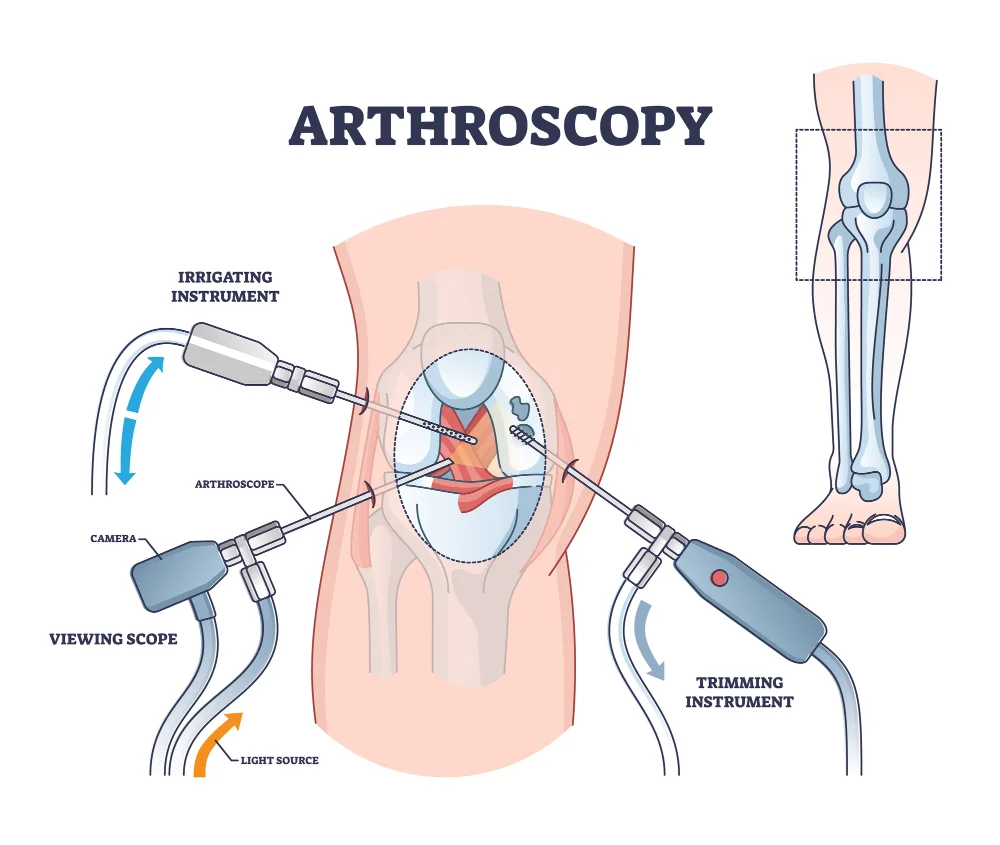
Arthroscopic surgery is a minimally invasive approach that may be used to repair or trim damaged meniscal tissue when surgery is appropriate. Depending on the tear and the patient's symptoms, treatment may help reduce mechanical symptoms such as catching or locking and improve knee function.
Whether a tear occurs suddenly or develops gradually, symptoms may include joint-line pain, swelling, catching, or locking that makes everyday movement more difficult. This guide covers how meniscal tears happen, how they are diagnosed, and what to expect from arthroscopic knee meniscal tear surgery in Los Angeles. If these symptoms sound familiar, schedule a knee consultation with LA Orthopedics for a clear diagnosis and treatment plan.
Understanding Meniscal Tears: Anatomy, Causes, and Types The Role of the Meniscus in Knee Joint Stability
Each knee has two C-shaped pieces of cartilage called the medial and lateral menisci. They sit between the thighbone and shinbone. They spread body weight evenly across the joint. The menisci help distribute load and protect the articular cartilage covering the knee joint. Loss of functional meniscal tissue can increase joint contact stresses and is associated with a greater risk of osteoarthritis over time. Surgeons work hard to save meniscal tissue whenever they can.
The menisci also help to stabilize the knee when you twist and pivot. They are like a wedge. This wedge stops the thighbone from sliding too far over the shinbone. A tear of the meniscus weakens this support. During sports, or even simple tasks such as climbing stairs, the knee can feel less reliable.
Acute Traumatic Tears vs. Degenerative Meniscal Tears
Traumatic meniscal tears usually happen during a sudden twisting motion. This often occurs while the foot is planted and the knee turns. Athletes who play soccer, basketball, and football are common patients. These tears often occur with other knee injuries, such as an ACL tear. They often come with a sharp pop at the moment of injury.
Degenerative tears develop differently. With age, meniscal tissue can become less resilient and more susceptible to tearing during normal activity, sometimes without an obvious injury. A person may simply rise from a chair or make an everyday movement and notice new pain along the joint line.
Common Meniscal Tear Patterns
Not all meniscal tears are the same. A bucket-handle tear is a long tear that can become inverted into the joint space and block motion. A radial tear extends from the inner edge of the meniscus outward, disrupting the circumferential fibers that help distribute load. If the flap is torn, a piece of tissue can become free and get caught between the bones. Horizontal tears divide the meniscus into upper and lower layers. Complex tears mix more than one pattern.
The shape and location of a tear help determine whether it can be repaired or needs to be trimmed.
Meniscus Tear Symptoms: When to Seek Orthopedic Evaluation
Mechanical Symptoms: Catching, Clicking, and Locking
One of the clearest signs of a meniscal tear is a mechanical symptom. This means the knee catches, clicks, or locks during movement. It often happens when a loose flap of tissue gets caught between the bones as the knee bends. Some patients describe a knee that briefly gets stuck and needs gentle shifting to move again.
Persistent catching or true locking warrants orthopedic evaluation, particularly when the knee cannot fully straighten. Imaging may be recommended depending on the examination, injury history, and suspected cause.
Joint Line Pain and Localized Swelling
Meniscal tears often cause pain in one spot. This spot sits along the inner or outer edge of the knee, known as the joint line. Surgeons check for this tenderness during a physical exam. It points fairly directly to the meniscus.
Swelling is another common symptom. It doesn’t always show up right away. Some patients notice a puffy, tight feeling within hours of an injury. Others develop fluid buildup slowly over a day or two. This often comes with stiffness that limits how far the knee can bend.
Giving Way and Joint Instability
A feeling of giving way can occur with a meniscal injury, but it is not specific to the meniscus. Pain, muscle inhibition, ligament injury, or other knee problems can produce a similar sensation.
This instability can lead people to avoid certain movements. If left unaddressed, it can weaken the muscles around the knee. An orthopedic evaluation can determine whether it comes from the meniscus, a ligament, or both.
Diagnostic Precision: How LA Orthopedics Evaluates Knee Pain
Before recommending surgery or conservative care, LA Orthopedics relies on a thorough evaluation that combines hands-on examination with advanced imaging
Clinical Examination & Special Orthopedic Tests
The examination may include joint-line palpation and maneuvers such as the McMurray or Apley tests. No single physical test confirms a meniscal tear, so findings are interpreted together with the patient's symptoms and injury history.
These tests are combined with a full injury history. This mix of testing and history helps narrow the diagnosis before ordering imaging.
High-Resolution MRI & Standing Radiographs
Standing X-rays are often an important part of the initial imaging evaluation. Because they are taken while the patient bears weight, they can reveal joint-space narrowing and other changes associated with osteoarthritis that may influence treatment decisions.
MRI is commonly used to evaluate the meniscus when imaging is clinically indicated. It can help identify a tear's location, pattern, extent, and displacement while also showing associated cartilage, ligament, or other knee abnormalities. These findings, together with factors such as tissue quality, tear chronicity, patient age and activity level, and the tear's location relative to the meniscus's vascular zones, help the surgeon determine whether repair may be feasible.
Non-Surgical vs. Surgical Management: Making the Right Choice
Indications for Arthroscopic Knee Surgery
Surgery may be considered when symptoms and tear characteristics suggest that nonoperative care is unlikely to provide adequate improvement or when a displaced tear causes significant mechanical restriction. Factors may include:

Persistent locking, where the knee actually catches or gets hung up
Failed conservative care with no improvement after a fair trial of non-surgical treatment
Repairable tears in appropriately selected patients, particularly when tear pattern, location, tissue quality, and clinical circumstances favor preservation
A displaced bucket-handle tear that causes true mechanical locking or limits knee motion may require more urgent surgical evaluation
Conservative Care: Physical Therapy, Injections, and Activity Modification
A meniscus tear doesn't necessarily mean surgery is next. For stable tears, especially degenerative ones without locking, conservative treatment is often the first step. This includes physical therapy and activity modification to decrease stress on the joint.
Medication and, in selected patients, injections may be considered to manage associated pain or inflammation. These treatments do not repair the torn meniscus itself, and the role of injections depends on the patient's overall knee condition, including whether osteoarthritis is present.
Surgical Options: Meniscus Repair vs. Partial Meniscectomy
Once surgery is recommended, the next step is choosing the right technique for the tear. The two main options, meniscus repair and partial meniscectomy, differ in goals, technique, and recovery time. The table below compares them across the factors that patients often ask about.
| Factor | Arthroscopic Meniscus Repair | Partial Meniscectomy |
|---|---|---|
| Primary Objective | Stitch and preserve original meniscal tissue | Trim damaged, non-healing tissue flap |
| When It May Be Considered | When tear pattern, location, tissue quality, and patient factors make healing and tissue preservation feasible | When unstable symptomatic tissue is not considered repairable |
| Surgical Technique | Suture anchors or inside-out stitching | Precision micro-shaver trimming |
| Post-Op Weight-Bearing | Varies by tear and repair technique; some patients require protected weight-bearing | Often weight-bearing as tolerated relatively soon, depending on surgeon instructions |
| Full Recovery Window | Often several months; varies by tear, repair, and activity goals | Often several weeks for basic recovery; higher-level activity may take longer |
| Long-Term Joint Protection | Maximum, preserves shock absorption | Selective, removes only unfixable tissue |
Arthroscopic Meniscus Repair (Suturing Vascular Tears)
Meniscus repair is generally considered when the tear's pattern, location, tissue quality, and patient factors provide a reasonable opportunity for healing. Tears closer to the outer vascular portion of the meniscus may have greater healing potential, but vascularity is only one factor in determining whether a tear is repairable.
Because repaired tissue needs time to heal, rehabilitation is usually more protective than after partial meniscectomy. Weight-bearing restrictions, brace use, range-of-motion limits, and crutch duration depend on the tear pattern, repair technique, and surgeon's protocol.
Partial Meniscectomy (Trimming Avascular Flaps)
Partial meniscectomy may be considered when unstable torn tissue is causing symptoms, and the tear is not considered suitable for repair. The surgeon removes as little damaged tissue as necessary while preserving as much functional meniscus as possible.
This procedure removes the smallest amount of tissue possible. It doesn’t remove the whole meniscus. Because there is no repaired tissue to protect, patients can usually bear weight almost right away.
For ongoing knee pain or mobility concerns, schedule a consultation with LA Orthopedics to explore the cause and possible treatment approaches.
What to Expect During Arthroscopic Surgery at LA Orthopedics
Outpatient Surgery & Anesthesia Options
Knee arthroscopy is generally performed with anesthesia, which may involve general anesthesia, regional anesthesia, or a combination depending on the patient, procedure, and anesthesia team.
Because the surgery is outpatient, patients need someone to drive them home afterward. Anesthesia and nerve blocks take time to wear off. Many patients spend a short time in a recovery area before going home.
Minimally Invasive Incisions & HD Video Visualization
During surgery, the surgeon inserts a thin arthroscope through a tiny incision near the knee. This tube has a small camera on the end. It shows a magnified, high-definition view of the joint on a monitor. A second small incision lets instruments enter to repair or trim the tissue.
Because these cuts are so small, surrounding muscle and soft tissue stay mostly undisturbed. The small portals used for arthroscopy generally cause less soft-tissue disruption and leave smaller scars than a traditional open approach.
Recovery Timeline & Rehabilitation Milestones
Recovery from arthroscopic knee surgery generally moves through the same stages, though how quickly a patient progresses depends on whether they underwent a repair or a meniscectomy.
The following is a general example rather than a universal rehabilitation schedule. Restrictions and milestones vary substantially between meniscus repair and meniscectomy and according to the tear, procedure, surgeon's protocol, and individual recovery.
Days 1 to 3 (Immediate Post-Op)
Rest, ice, and elevation, along with pain medication and simple care of the small dressings.
Week 1 (Early Mobility)
Begin gentle range-of-motion exercises, along with muscle activation and an initial physical therapy visit.
Weeks 2 to 4 (Gait & Strength)
Meniscectomy patients typically stop using crutches, work on full knee extension, and begin basic strength exercises.
Weeks 4 to 6 (Return to Daily Activities)
Many patients resume driving, daily tasks, and stationary cycling. Repair patients often still wear a protective brace.
Months 2 to 3 (Advanced Conditioning)
Depending on the procedure and progress, rehabilitation may advance toward cardiovascular conditioning, strength work, balance, and sport-specific preparation.
Months 3 to 6+ (Return to Higher-Level Activity):
Patients recovering from meniscus repair may gradually return to running, impact activity, or pivoting sports once healing, strength, motion, and functional testing meet the surgeon's criteria.
Recovery speed varies by tear type, procedure, age, rehabilitation progress, and individual healing.
Why Choose LA Orthopedics for Knee Meniscal Tear Care
Successful meniscal treatment depends on several factors, including the tear pattern, tissue quality, associated knee conditions, rehabilitation, and surgical decision-making. Surgeon training and experience are also important when determining whether damaged tissue can be preserved.
Fellowship-Trained Orthopedic Knee Specialists
Dr. Shahab Mahboubian at LA Orthopedics is a fellowship-trained sports medicine and joint preservation specialist. His extra training focuses on knee and sports-related injuries, giving him a deeper understanding of how to treat meniscal tears and other knee conditions.
This experience shows in his surgical volume. Dr. Mahboubian regularly performs arthroscopic knee procedures, building the refined skill that comes only through repetition and supporting careful, consistent decision-making from case to case.
Joint-Preserving Surgical Philosophy
Preserving viable meniscal tissue when feasible helps maintain its load-distributing function and may reduce some of the long-term joint consequences associated with meniscal tissue loss.
This approach calls for more surgical judgment than a standard, uniform method. When repair is appropriate, the goal is to preserve viable meniscal tissue while balancing healing potential, recovery needs, and long-term knee function.
Integrated Physical Therapy & Local Los Angeles Care
Surgery is just one part of getting back to full strength. LA Orthopedics partners with physical therapy providers throughout the greater Los Angeles area, so patients have convenient, nearby options for the months of rehab that follow. This local access makes it easier to stay consistent with appointments during a recovery that can stretch from several weeks to several months.
Frequently Asked Questions (FAQ)
How long does arthroscopic knee surgery for a meniscal tear take?
Outpatient knee arthroscopy typically takes 30 to 60 minutes. Including prep time and recovery from anesthesia, patients usually spend about 2 to 3 hours at the surgical center before going home.
How quickly can I walk after meniscus tear surgery at LA Orthopedics?
Walking after meniscus surgery depends on the procedure. After partial meniscectomy, many patients can bear weight as tolerated relatively soon, sometimes using crutches for comfort. Meniscus repair often requires a more protective approach, but weight-bearing restrictions, brace use, and crutch duration vary according to the tear, repair technique, and surgeon’s protocol.
Will I need physical therapy after arthroscopic knee surgery?
Rehabilitation is an important part of recovery after meniscus surgery. Some patients benefit from formal physical therapy, while the specific program depends on the procedure, recovery, and surgeon’s recommendations. Meniscus repair generally requires a more structured and protective rehabilitation protocol than partial meniscectomy.
Can a torn meniscus heal on its own without surgery?
Some small, stable meniscal tears may become asymptomatic or heal without surgery, particularly when they are located in the more vascular outer portion of the meniscus. Whether nonoperative care is appropriate depends on the tear pattern, symptoms, stability, associated injuries, activity demands, and other patient factors. Displaced tears that cause true locking or significant motion loss warrant prompt orthopedic evaluation.
What is the difference between meniscus repair and meniscectomy?
Meniscus repair uses sutures to preserve and stabilize repairable meniscal tissue, but recovery is usually longer because the tissue needs time to heal. Partial meniscectomy removes unstable tissue that cannot be repaired while preserving as much healthy meniscus as possible. Recovery is often faster than after repair, although symptom improvement and return to activity vary.
When can I drive after arthroscopic meniscus surgery?
Driving clearance varies based on which knee was treated, whether the patient underwent repair or meniscectomy, use of a brace or crutches, medication use, strength, reaction time, and the surgeon’s instructions. Patients should not drive until they can safely and confidently control the vehicle and have been cleared according to their postoperative plan.
Is knee arthroscopy painful?
Pain and soreness after knee arthroscopy vary by patient and by the procedure performed. Because arthroscopy uses small incisions, discomfort is often manageable with the postoperative plan recommended by the surgical team, which may include ice, elevation, medication, and regional anesthesia when appropriate.
What are the risks of leaving a meniscal tear untreated?
Some symptomatic or unstable meniscal tears can continue to cause pain, swelling, catching, or locking. Meniscal injury is also associated with osteoarthritis risk, although the long-term course depends on the tear, underlying cartilage health, age, activity, alignment, and other knee factors.
Schedule Your Knee Evaluation at LA Orthopedics
There is no single treatment approach for every knee tear. Factors such as the tear’s location, severity, your knee anatomy, and imaging findings all play a role in deciding what comes next. A surgeon can bring these details together during an in-person evaluation.
If knee pain, catching, locking, or recurrent swelling is interfering with your activity, an orthopedic evaluation can help determine whether conservative care or surgical treatment is appropriate. Schedule a consultation with Dr. Shahab Mahboubian at LA Orthopedics to get clarity on your knee and a plan to move forward.
CONTACT LA ORTHOPEDICS
This article provides general medical information and is not formal medical advice. Individual diagnostic findings and recovery timelines vary. Consult a licensed orthopedic surgeon for an accurate diagnosis and personalized treatment plan.