

Last Updated: September 10, 2026
Trigger point injections at LA Orthopedics are a minimally invasive treatment used for painful myofascial trigger points, often described as muscle knots. During treatment, the physician places a small amount of local anesthetic, sometimes with a corticosteroid, into the affected muscle. The goal is to reduce localized pain and muscle irritation so patients can move more comfortably and participate in rehabilitation when appropriate.
Maybe you have a stubborn knot in your shoulder. Maybe your neck won’t loosen, or your headaches start at the base of your skull. This guide can help you understand how trigger points form and which conditions respond to trigger point injection therapy. It also explains what a visit to LA Orthopedics involves and answers common questions before you see a pain management specialist in Los Angeles.
Trigger point injections are a targeted, minimally invasive treatment that may provide relief for appropriately selected patients.
Understanding Myofascial Trigger Points & Muscle Knots
A myofascial trigger point is not the same as everyday muscle soreness. It is a tender spot inside a tight band of muscle. That spot stays contracted even when the rest of the muscle is at rest. Pressing on it brings back the pain.
Trigger points are common in people who sit at a desk for long hours. They also show up in physically demanding jobs and in old injuries that never fully healed. Some trigger points improve with activity modification, stretching, heat, physical therapy, or other conservative measures. Persistent trigger points may require further evaluation when symptoms continue despite self-care.
Pathophysiology of a Trigger Point
Several mechanisms have been proposed to explain trigger point formation. One theory involves sustained contraction within small groups of muscle fibers, which may contribute to local changes in blood flow, muscle sensitivity, and pain signaling. Repetitive strain, injury, and prolonged muscle loading may contribute to this process.
With less blood flow, waste builds up around the tight fibers. This makes the muscle more sensitive to touch. That is why a trigger point can feel tender even before you press on it.
Active vs. Latent Trigger Points
Not every trigger point acts the same way, and the difference matters for treatment. An active trigger point causes pain on its own. No one needs to press on it. It also sends pain to a set spot elsewhere in the body.
A latent trigger point only hurts when someone presses on it. It can still limit motion and add to stiffness, even without steady pain. Many patients carry latent trigger points for months without knowing it, until an exam finds them.
Common Anatomical Locations
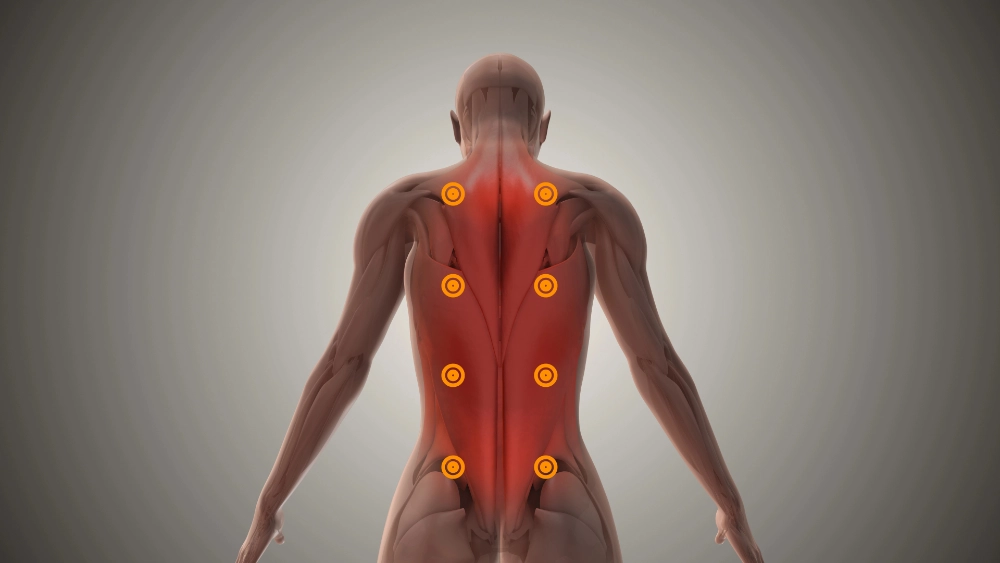
Certain muscles form trigger points more often than others. This depends on daily posture and movement. The upper trapezius runs from the neck to the shoulder. It is one of the most common spots, especially for people who look at a screen most of the day.
Other frequent spots include the levator scapulae along the side of the neck and the rhomboids between the shoulder blades. The quadratus lumborum in the lower back and the gluteal muscles are common too. Each spot tends to send pain along its own path. This helps a physician trace the source during an exam.
Symptoms & Conditions Treated with Trigger Point Injections
Trigger point injections are not a first step for every ache. Physicians usually turn to this treatment when a specific muscle problem has not improved with rest, stretching, or oral medicine. The trigger point must also be clear on exam.
At LA Orthopedics, this treatment works best for pain with a clear anatomical source. It is less suited to pain spread across the whole body. Here are the conditions treated most often.
Myofascial Pain Syndrome (MPS)
Myofascial pain syndrome is a chronic regional muscle pain syndrome characterized by one or more active trigger points. With MPS, the pain is related to hyperirritable loci in tight bands of skeletal muscle. Patients often describe a deep ache that doesn’t go away with rest. When symptoms persist despite conservative care, trigger point injections may be considered as one part of a broader treatment plan.
Anti-inflammatories, massage, and basic stretching sometimes don’t do the trick. When those fail, a trigger point injection may help reduce localized pain and make stretching, movement, or physical therapy more tolerable. This relaxes the muscle and allows physical therapy to work.
Tension Headaches & Cervicogenic Neck Pain
Trigger points in muscles of the neck and upper shoulders can produce referred pain into the head and may contribute to headache symptoms in some patients. Because headaches can have many causes, evaluation is important to determine whether a myofascial pain pattern is contributing before an injection is recommended.
Patients with this pattern often notice that pressing one spot at the back of the neck brings back their exact headache. Treating that trigger point directly can reduce how often muscle-driven headaches occur.
Chronic Low Back Pain & Sciatica-Like Muscle Spasms
The piriformis is deep in the buttock, and the quadratus lumborum is in the lower back. Both can tighten enough to mimic a pinched nerve. Piriformis syndrome, for example, can send pain down the back of the leg. This pattern can mimic sciatica, even without actual nerve compression.
Because muscular pain can resemble lumbar radicular pain, careful evaluation is important before treatment. When examination findings support a myofascial source rather than nerve-root compression, treatment can be directed toward the affected muscle.
Comparative Decision Framework: Trigger Point Injections vs. Dry Needling
Patients researching muscle knot treatment often find two options that sound alike but work differently. These are trigger point injections and dry needling. Both target the trigger point, but the tools, the provider, and what happens during the visit differ.
| Parameter | Trigger Point Injection (TPI) | Dry Needling |
|---|---|---|
|
Injected Solution |
Local anesthetic (lidocaine or bupivacaine), with or without a corticosteroid | None; a solid, dry filiform needle only |
|
Primary Mechanism |
Needle stimulation of the trigger point combined with the local effects of the injected medication | Needle stimulation of the trigger point without injected medication |
|
Practitioner Licensing |
Performed by an appropriately trained and licensed medical clinician | Provider eligibility varies by state scope-of-practice requirements and professional licensure |
|
Immediate Comfort |
Anesthetic numbs the site right away | Can cause temporary soreness after the session |
|
Insurance Coverage |
Often covered by health insurance when medically necessary | Often billed as cash-pay, out-of-pocket |
|
Speed & Duration of Relief |
Response and duration of improvement vary by patient and underlying condition | Response and duration also vary; repeat sessions may be recommended depending on the treatment plan |
Neither option is automatically better for every patient. A physician at LA Orthopedics first weighs your diagnosis, treatment history, and insurance coverage. Some patients even use both, at different stages of care.
Talk to a specialist about which combination of treatments fits your pain pattern. Book your consultation with LA Orthopedics to get started.
What to Expect During the Procedure at LA Orthopedics
A trigger point injection is a quick, in-office procedure. It is not a major surgery. Many patients are surprised by how brief and manageable the visit is.
The appointment has two main steps: the exam and the injection. Knowing what each step involves tends to ease the nerves many patients feel beforehand.
Clinical Evaluation & Manual Palpation
Before any needle touches your skin, your physician examines the area by hand. This finds the tight muscle band and the exact tender spot inside it. This step is called manual palpation. The physician presses along the muscle to feel for the rope-like tightness that marks a trigger point.
This exam also helps rule out other causes of your symptoms, such as a herniated disc or joint inflammation. Precise location matters because injecting even slightly off-target reduces how well the treatment works.
Precise Injection Technique & The Local Twitch Response
Once the physician finds the trigger point, they insert a fine needle directly into the tight band. They inject a small amount of local anesthetic at the same time. As the needle reaches the trigger point, many patients feel a quick, involuntary muscle twitch. Doctors call this the local twitch response. A brief involuntary muscle twitch, known as a local twitch response, may occur when the needle stimulates the affected muscle fibers. A twitch response may support identification of the targeted area but is not required for successful treatment.
The full procedure usually varies by treated area. Many patients tolerate it well, with only brief, mild discomfort. Because it happens in an outpatient setting, you can expect to leave the same day with no extended recovery time.
Recovery, Results & Integrating Physical Therapy
Recovery from a trigger point injection tends to unfold in stages, with many patients following a similar path from one week to the next. This makes it easier to plan physical therapy around it. The timeline below reflects what patients often experience. Results still vary based on how severe the muscle knot is and how closely you follow physical therapy.
Immediately After the Injection
Temporary numbness or pain relief may occur when a local anesthetic is used. Mild soreness at the injection site is also possible.
Over the Next Several Days
Response varies. Some patients notice improvement relatively quickly, while others experience more gradual changes. If a corticosteroid is used, its effects may take longer to become noticeable than those of the local anesthetic.
Returning to Movement and Rehabilitation
Your physician will advise you about activity after the injection. When appropriate, stretching, physical therapy, ergonomic changes, and strengthening may be used to address factors contributing to recurrent muscle pain.
Longer-Term Results
The duration of improvement varies. Trigger point injections may be one component of a broader treatment plan rather than a permanent solution on their own.
On their own, trigger point injections rarely resolve the underlying muscle pattern; the long-term change comes from what happens after, in physical therapy and daily movement habits.
Why Choose LA Orthopedics for Trigger Point Therapy
Accurate diagnosis and careful anatomical localization are important when considering a trigger point injection. The clinician must first determine whether the painful area is myofascial and whether an injection is appropriate.
LA Orthopedics built its trigger point program around two things patients ask for most. First, a physician who understands the anatomy involved. Second, a plan that doesn't stop at the injection.
Board-Certified Pain Management & Orthopedic Specialists
At LA Orthopedics, board-certified pain management and orthopedic physician Dr. Shahab Mahboubian performs injections and works daily with muscle and spine anatomy. That experience is essential when the trigger point sits close to sensitive structures, for example, the lung near the upper trapezius, where careful needle placement reduces the risk of complications.
Patients also benefit from a physician who reads the wider clinical picture. If your pain turns out to be something other than a trigger point, the same specialist can identify it. Your care then moves in the right direction.
Comprehensive Multi-Modal Pain Strategy
LA Orthopedics doesn’t treat the injection as a single, isolated event. Care typically combines the injection with physical therapy referrals, posture training, and practical ergonomic guidance you can use at home or work.
This combination addresses two things at once: the immediate muscle knot and the habits that likely caused it. Patients who follow through on the full plan, not just the injection visit, tend to see the most lasting results.
Frequently Asked Questions (FAQ)
How long does a trigger point injection procedure take?
A trigger point injection is a fast outpatient procedure. It typically takes only 5 to 10 minutes to perform in the office.
How quickly do trigger point injections relieve pain?
Local anesthetics like lidocaine can relieve pain within minutes. If a corticosteroid is included, the fuller anti-inflammatory effect usually builds over the next 2 to 5 days.
Are trigger point injections covered by insurance?
Coverage varies by insurance plan and medical-necessity requirements. Some plans cover trigger point injections for qualifying myofascial pain when appropriate clinical findings and prior conservative treatment are documented. Patients should verify their individual benefits and coverage requirements before treatment.
How long does relief from a trigger point injection last?
The duration of relief varies considerably. Some patients experience short-term improvement, while others may have relief that lasts longer. Response depends on the underlying condition, treatment approach, and whether contributing factors are addressed.
What is injected during a trigger point injection?
Trigger point injections commonly use a local anesthetic such as lidocaine or bupivacaine. A corticosteroid may sometimes be included depending on the clinician's treatment approach, although it is not required for a trigger point injection.
What is the difference between dry needling and a trigger point injection?
A trigger point injection uses a needle to place medication, typically a local anesthetic, into the targeted muscle. Dry needling also targets muscle trigger points but does not inject medication. Who may perform dry needling depends on state scope-of-practice and professional licensing requirements.
Are there any side effects or downtime?
Side effects are usually minor. They may include soreness at the injection site for 1 to 2 days. Many patients return to light daily activities right after the appointment.
How many trigger point injections can you get?
Repeat injections may be considered when symptoms return and the previous treatment provided meaningful improvement. The timing and number of injections depend on the patient's response, clinical circumstances, medication used, and applicable insurance requirements.
Schedule Your Pain Evaluation at LA Orthopedics
Muscle knots respond differently from one patient to the next, so the details above are a starting point and not an exact diagnosis. What actually happens during your visit depends on where the tension sits, how long it has been building, and what your physician finds once they examine the muscle directly.
If stiff shoulders, low back tightness, or recurring headaches have become part of your routine, a focused exam can identify what is driving them and whether trigger point injections are the right step forward. Schedule your consultation with LA Orthopedics and get a diagnosis from a pain management specialist in Los Angeles.
CONTACT LA ORTHOPEDICS
LA Orthopedics
Website: https://laorthopedics.com/
Location: Los Angeles, California
This guide provides general medical information and is not formal medical advice. Individual diagnostic findings and recovery timelines vary. Consult a licensed physician or pain management specialist for an accurate diagnosis and personalized treatment plan.